


News
Note that the releases are accurate at the time of publication but may be subject to change without notice. This page shows only the most recent items. For the full archive of press releases please click "Search by category or year."
Mitsubishi Electric Confirms World’s First Self-recovery Property of Highly Oriented Pyrolytic Graphite
 PDF Version (PDF:712.1 KB)
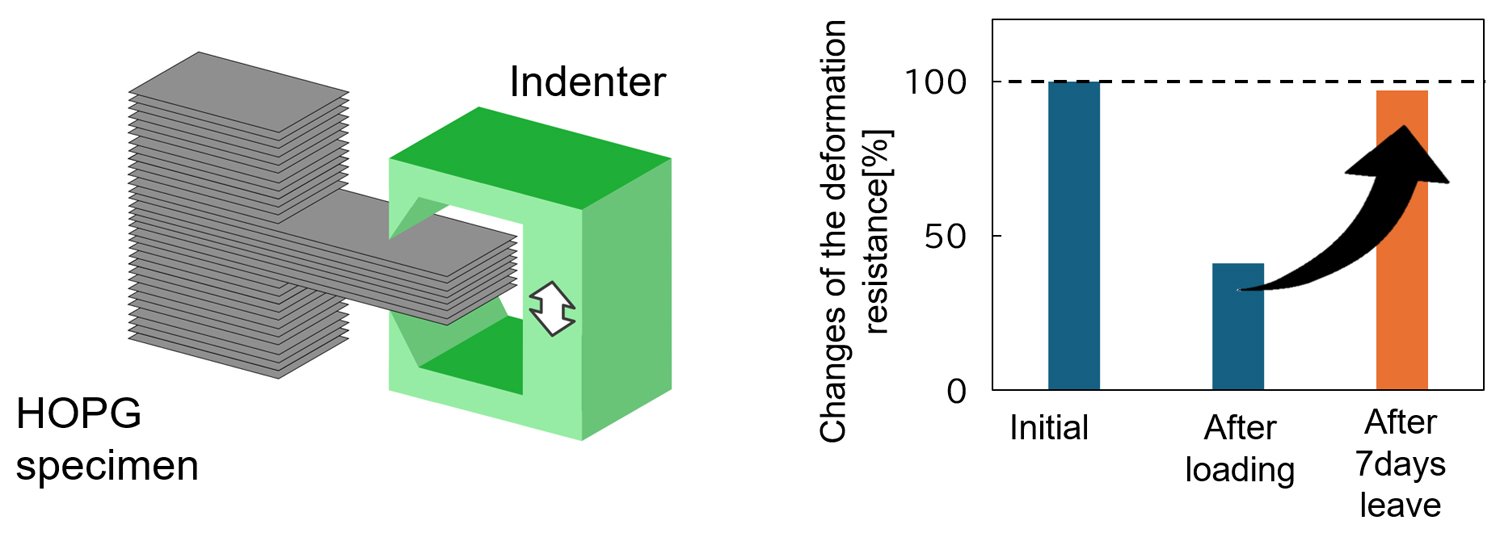
Test method and confirmed self-recovery characteristics
TOKYO, January 27, 2026 - Mitsubishi Electric Corporation (TOKYO: 6503) announced today that it has confirmed the world’s first1 self-recovery property of highly oriented pyrolytic graphite (HOPG),2 a van der Waals (vdW)-layered material,3 in joint research with the Solid Mechanics Laboratory (Hirakata Laboratory) of Kyoto University's Graduate School of Engineering. This achievement is expected to extend the operational lifetime of micro electro mechanical systems (MEMS)4 by utilizing vdW-layered materials, thereby contributing to the reliability of devices equipped with MEMS.
The demand for MEMS including accelerometers and pressure sensors is rapidly expanding, driven by the advancement of smartphone functionality, the increasing sophistication of autonomous driving and safety controls in automotive systems, and the widespread adoption of wearable devices. There is a growing need to achieve weight reduction while ensuring durability capable of withstanding prolonged vibration and shock. Against this backdrop, the application of vdW-layered materials—lightweight, flexible, and possessing high strength—to MEMS has been regarded as promising. However, producing micro-scale test specimens of vdW-layered materials is technically challenging, and testing methods have not yet been established. As a result, their medium- to long-term reliability, particularly fatigue properties under repeated loading, has remained unexplored until now.
Mitsubishi Electric, in collaboration with Kyoto University, has succeeded in fabricating micro-scale test specimens of HOPG and has further established a new testing method in which the specimens are subjected to repeated bending loads to induce shear deformation. Analysis of the test results has been ongoing, and now, for the first time in the world,1 the company has confirmed that HOPG specimens exhibit a self-recovery property, whereby they soften as the number of load cycles increases, and then, over time, their mechanical properties, including hardness, recover. This discovery suggests the potential to utilize HOPG, which inherently dissipates vibrational energy due to its layered structure, as a vibration absorption mechanism5 equipped with the ability to recover from vibration-induced fatigue. Applying such a mechanism is expected to contribute to the development of highly reliable devices that are resistant to damage even in continuous vibration environments. Going forward, this fatigue testing method will be applied to other vdW-layered materials, advancing research aimed at extending the operational lifetime of MEMS.
The results of this research were selected for publication in the international journal Diamond and Related Materials.6
- 1
According to Mitsubishi Electric research as of January 27, 2026.
- 2
Highly pure and well-oriented graphite in which the orientation of individual graphite crystallites matches.
- 3
A material that uses the weak attraction between molecules to form a structure.
- 4
A micron-level device that integrates mechanical components, sensors, actuators, and electronic circuitry on a single substrate.
- 5
By absorbing and dispersing vibration energy applied from the outside, the vibration and impact of the object are reduced, and damage and fatigue are suppressed.
- 6
https://www.sciencedirect.com/journal/diamond-and-related-materials
Inquiry
-
Customer Inquiries
Advanced Technology R&D Center
Mitsubishi Electric CorporationFax: +81-6-6497-7285